The Energy Price Cap & What It Means
It’s safe to say that the last few years have been turbulent and uncertain for our energy bills. A pandemic, rising tensions on the Russo-Ukrainian border, and dwindling natural resources all drove prices to record highs and homeowners and businesses to desperation. In that time, the energy price cap was so often the source of discussion.
But with energy insecurity so often clouding our vision, there’s so much that’s still unclear, or that warrants further explanation. That’s what we’ll be addressing with Tariff’s latest article, diving into what the energy price cap means for you, how it’ll affect your bills, and how it’s set to change as we venture further into 2025.
As business energy experts with an eye towards both commercial and domestic energy, we’re ideally positioned to give impartial, fact-driven advice. We’ll also look at practical measures you can put into place to combat rising energy prices, and how switching your provider could be the path forward.
What Is The Energy Price Cap?
The energy price cap refers to the maximum amount you’ll pay for your energy bills on an annual basis.
It’s based on the energy usage of an average household (thought to be around 2.4 people) and is set by the UK government’s energy regulator Ofgem.
In the words of Ofgem, this is designed to ensure that energy costs are both “fair”, and that they “reflect the cost of energy”. This means that you shouldn’t have to pay as much when energy is more widely available, but also that when it’s more difficult or costly to provide, you’ll pay slightly more as a means of accounting for the price difference.
The energy price cap applies to the vast majority of UK energy bill payers, and covers those who pay via:
- Standing order or direct debit
- Standard credit (meaning you pay when you receive your bill via email or in the post)
- Pre-payment meters
- Economy 7 (E7) meters
It was first introduced in January 2019 in response to growing uncertainties around natural gas and oil prices and has been in place since to better reassure energy customers of the price they’ll pay.
It was shifted into more public focus with the energy crises we’ve seen in recent years, as well as during the pandemic where many people were more reliant upon the energy they used at home. That also applied to businesses open during that time, which experienced a surge in the power they used for costs like heating, lighting and essential power.
How Much Is The Energy Price Cap?
As of the 1st January 2025, the energy price cap in the UK is £1,738 per year.
This is in place until 31st March 2025, and is set to be reviewed on the 25th February 2025, in line with Ofgem’s outlined calendar for energy price cap forecasts. It’s a 1.2% increase from the previous quarter (1st October to 31st December 2024), going from £1,717 to £1,738 per year.
The full breakdown of what makes up the costs is outlined on Ofgem’s website, but we’ve also laid it out below:
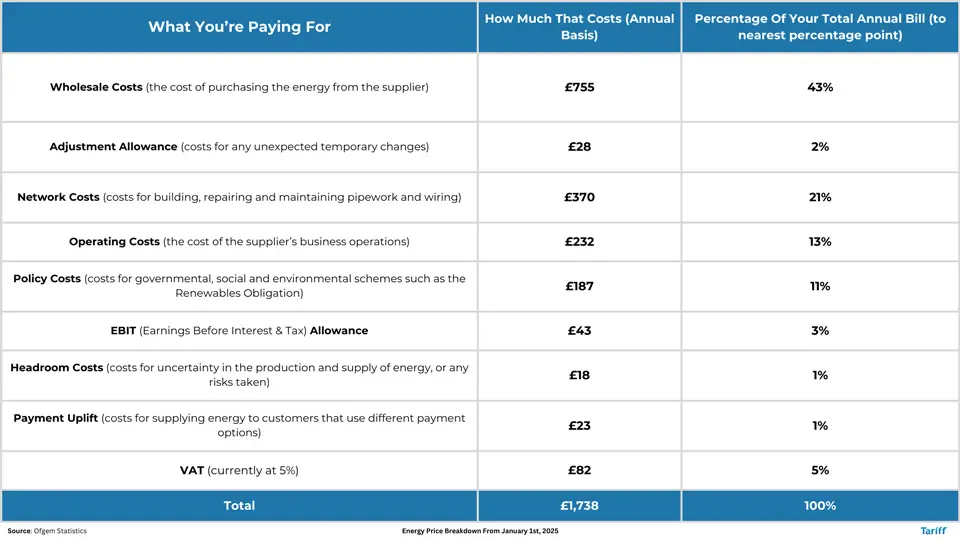
You’ll notice that several different costs aren’t directly related to the energy you consume, such as operating or policy costs. This has long been the case, and although these rarely change alongside the price cap, they still form part of what you’ll pay each year. You cannot opt out of these charges.
Energy providers must comply with these, but individual suppliers may opt to charge less if they wish to do so. If you’d like to, you’re able to request a breakdown of your energy bill costs from your supplier.
When Does The Energy Price Cap Change?
The energy price cap is scheduled to change on April 1st, 2025. It was previously set at £1,738 on January 1st, 2025.
While the current UK energy price cap of £1,738 was brought into effect on the 1st January 2025, Ofgem reviews these on a 3-monthly basis. The next pricing review is scheduled for the 25th of February 2025 and will impact the price cap from the 1st of April 2025 onwards.
There’ll be multiple reviews throughout the year in a similar timeframe. Here’s when you can expect the prices to change, as well as when Ofgem are likely to announce its new price cap:
- A review is set to take place on the 25th February 2025 to determine the energy price cap between the 1st April and the 30th June 2025.
- A review is scheduled for the 26th May 2025 to determine the energy price cap between the 1st July and the 30th September.
- The final confirmed review of the year is set for the 27th August 2025, determining the energy price cap between the 1st October and the 31st December.
While Ofgem has yet to announce when they’ll be providing the price cap details for the start of 2026, we predict this to be on or around the 26th November 2025, which could help us forecast how the energy price cap is set to change in the first quarter of the new year.
How Does The Energy Price Cap Affect My Bills?
The current energy price cap in the UK is set at £1,738 per year. The average household should not pay more than this for their home energy bills.
While Ofgem’s price cap does limit the amount an average household can expect to pay per year, it’s impossible to confirm how this will affect your monthly payments. There are good reasons for this, however – our energy usage from month to month can fluctuate, especially over school holidays or when we turn up the heating during winter.
In an ideal situation, we’d use the same amount of energy each month, and be able to provide more comprehensive energy price cap forecasting, but this isn’t always the case. Some providers can give you a flat rate each month, but metered customers will be able to receive a price that’s more reflective of their usage.
For instance, your average home will naturally use more energy in the winter months for heating and lighting, meaning a higher monthly bill in, say, December. But summer might mean you’re using less energy and opting for natural heat, which means July will likely be a considerably lower bill than those winter months.
What is certain, however, is that domestic energy bills for the average household will not cost more than £1,738 over the course of a year. Ofgem regulates these prices closely, and individual providers cannot exceed that amount without strict penalties.
Can I Pay Less Than The Energy Cap?
Yes. The energy price cap is just the maximum your average household can expect to pay for their annual energy bill. While this shouldn’t exceed £1,738, there’s nothing to say that simple changes to your energy usage won’t allow you to pay less than that.
Some providers also offer fixed-rate payments that are below that Ofgem cap, but these are few and far between. Smaller households, particularly flats and apartments, will often see lower bills than Ofgem’s price cap.
Is There An Energy Price Cap For Businesses?
No, there is not. Support for businesses ended in March 2024, and the government has yet to announce any similar energy price cap initiatives for commercial users.
While businesses across the country are arguably some of our largest consumers of energy, there’s yet to be any concrete support or energy cap for those businesses. In fact, many have clamoured to go back to some of the support the government provided during the worst times of the energy crisis back in 2023.
You might recall a couple of key initiatives – namely the Energy Bill Relief and the Energy Bills Discount Schemes – that proffered support to businesses, but these have yet to be reinstated since their removal in early 2024, with no plans from either the previous or current government to do so.
With many businesses still grappling with the rising rates of energy on both the commercial and domestic fronts, it’s naturally led to some concerns. Indeed, energy prices have been attributed to the closure of thousands of businesses over the last few years, and understandably so.
There are options available, though, and Tariff is on hand to guide you and your business through the process with aplomb.
Frequently Asked Questions
Does The Energy Price Cap Limit The Maximum Amount I Will Pay For Energy?
No, this is the most common misunderstanding about the cap. The energy price cap does not limit your total annual bill. Instead, it limits the maximum price a supplier can charge you per kilowatt-hour of gas and electricity, as well as the daily standing charge to keep your home connected. The annual figure you see in the news is simply an estimate for a household with average energy usage. If you use more energy than average, your total bill will still be higher than the capped amount.
Who Is Protected By The Energy Price Cap?
The cap only protects consumers who are on a standard variable tariff, which is often called a default tariff. You are likely on this type of plan if you have never actively switched energy tariffs, if your previous fixed-term contract ended and you were automatically rolled over, or if your old supplier went bust and a new one took over your account. The cap does not apply to fixed-rate tariffs, certain green tariffs, or commercial business energy contracts.
How Often Does The Energy Price Cap Change, And Who Sets It?
The cap is set and regulated by Ofgem, the independent energy regulator for Great Britain. Ofgem reviews and updates the cap four times a year, with changes taking effect on the first of January, April, July, and October. Adjusting the cap every three months ensures that any drops in wholesale energy costs are passed on to you quickly, while also allowing suppliers to adjust when global energy markets rise.
How Does Ofgem Calculate The Level Of The Price Cap?
Ofgem calculates the cap using a formula that reflects the real-world costs energy suppliers face. The biggest and most volatile factor is the wholesale cost of buying gas and electricity on global markets. The formula also factors in network costs to maintain the physical pipes and wires, operating costs like customer service and billing, government environmental levies, and the standard five percent domestic VAT.
Should I Stay On A Price-Capped Variable Tariff Or Switch To A Fixed Tariff?
It depends on whether you value flexibility or financial predictability. Staying on a standard variable tariff means your prices will fluctuate with Ofgem’s quarterly updates, but you can switch to a new deal at any time without paying exit fees. On the other hand, locking in a fixed-rate tariff protects you from seasonal price spikes and gives you predictable monthly bills for a set period, though you may face a penalty fee if you decide to leave the contract early.
Combat Rising Energy Costs With Tariff’s Dedicated Switching Service
In place of a business energy price cap, the ideal way to deal with soaring energy costs is by switching suppliers. There’s no science or trickery behind it – business energy providers are in constant competition, and by switching you’re taking advantage of the offers they put in place to entice new customers.
This can be where it becomes a sticking point, though, especially with mountains of research and paperwork to tackle alongside your usual business operations. Tariff removes all that stress from the situation, taking the utmost care and attention in finding an energy deal that aligns with exactly what your business demands.
Whether it’s a better price point (so often the focus of many of our clients), better deals, or more commitments to the environment, our trusted energy experts are committed to scouring the market for a deal that’s not just cheaper, but one that resonates with what you need.
Beat the post-price cap blues with Tariff today, and get in touch with our knowledgeable team to discover more about how we can cut costs without compromising quality when it comes to your business energy.
Recent Blogs
Understanding Your Business Gas Bill: Complete Guide to Charges, Taxes & Hidden Fees.
View ArticleBy
Are you ready to save the planet and money?

Save Up To 40% Off Your Utility Bills

National Coverage

Energy Consultant
Energy Consultant
Sophie is an Energy Expert specialising in energy efficiency, renewable energy, and practical energy advice. She writes clear, research-led content that helps consumers understand energy tariffs, reduce energy costs, and make informed decisions about their energy use.